What is Light?
Back to: Basic Lighting Terminology
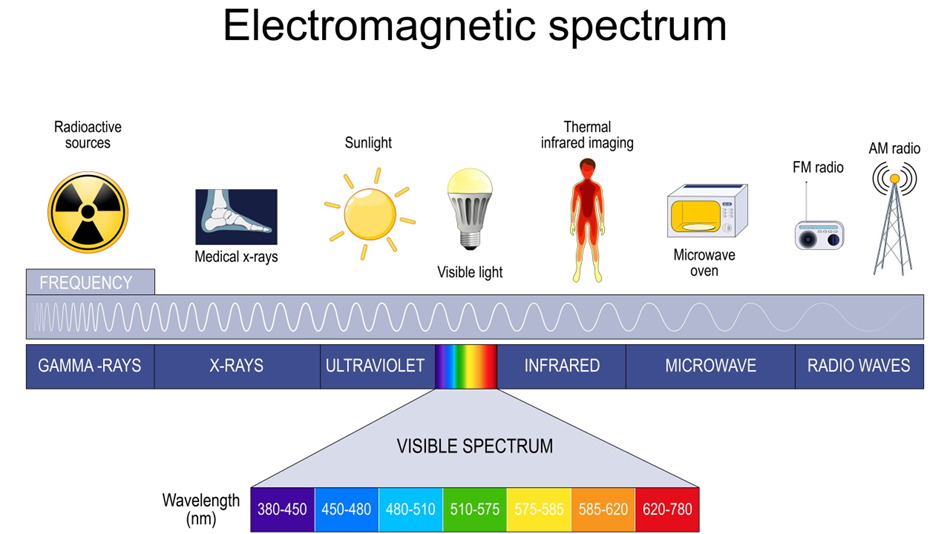
Light = Visible Electromagnetic Radiation (EMR)
Electromagnetic radiation is a form of energy that travels as waves through space, consisting of oscillating electric and magnetic fields. It encompasses a broad spectrum, including radio waves, microwaves, infrared, visible light, ultraviolet, X-rays, and gamma rays, which vary in wavelength and frequency. The human eye can see EMR as visible light in wavelengths from 380 – 780 nm
How do we perceive Colour?
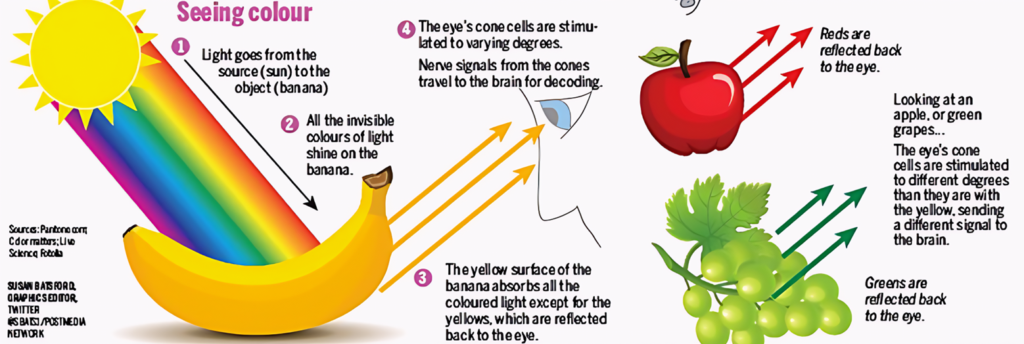
We perceive colour through a partnership between light, the photoreceptor cells (cones) in our retina, and our brain’s visual processing centres. Light reflects off objects and enters the eye, where cones detect specific wavelengths of light and send signals to the brain. The brain then interprets the combined signals from these different types of cones to create the perception of a specific colour.
How do we see Brightness?
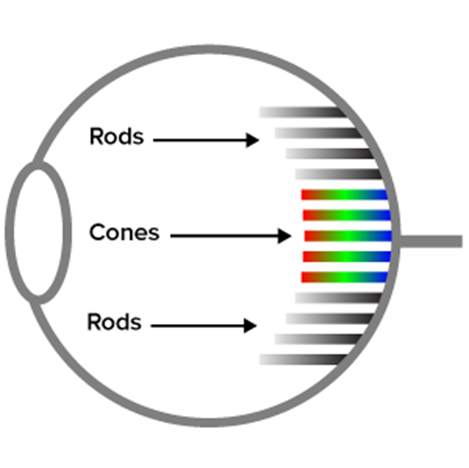
We see brightness because light enters the eye and strikes the retina, where rods and cones convert it into signals. Cones work in brighter conditions and give us colour vision (chromatic), while rods work in low light (monochromatic). Our brain doesn’t just measure lux levels, it interprets brightness by comparing contrasts and adapting to different light environments, which is why we can see in both sunlight and near darkness.
How does the human eye adapt?
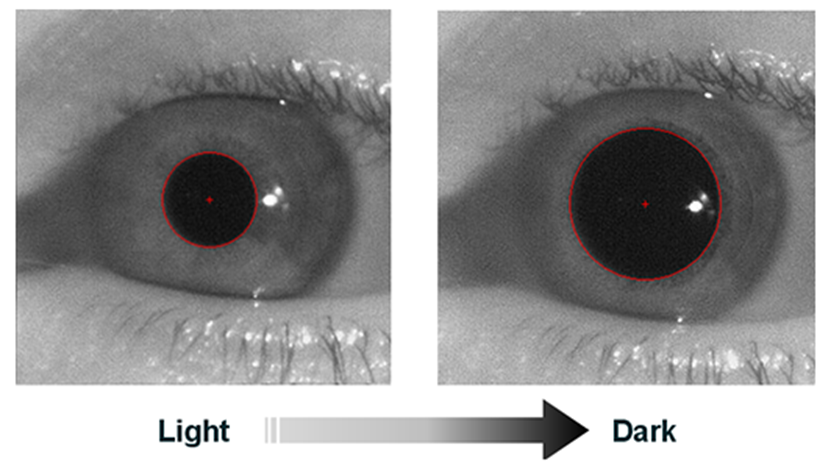
The human eye adapts to different light levels through three modes of vision. In bright conditions (daylight), cones dominate, giving us sharp vision and full colour. In darkness, rods take over, allowing us to detect movement and shades of grey but with limited detail. Between these extremes, at dawn or dusk, both rods and cones work together this is mesopic vision. Pupil size also changes to regulate how much light enters the eye. Importantly, adaptation is asymmetric: moving from dark to bright is fast, but adjusting from bright to dark takes much longer.